Active Ingredients in Livestock Mosquito Coils?
What are the active ingredients in livestock mosquito coils? This is a common question when farmers evaluate products. Compliant livestock coils generally use pyrethroid-class compounds as their active mosquito-repelling ingredients, lowering mosquito and fly density in pens through a dual action of contact killing and repellency. This article explains the active-ingredient principles behind MUWEISHI livestock coils, why they suit large-area overnight farm protection, and how the formulation differs from household coils. For safe use, see Is Livestock Mosquito Coil Safe?.
1. Active Ingredients: Compliant Pyrethroid Formulas
Compliant livestock coils typically rely on pyrethroid-class ingredients as the core active substance. These compounds are synthetic modifications built on the structure of natural pyrethrin, retaining low residue and low mammalian toxicity while offering better stability and cost. They are widely adopted in livestock settings worldwide.
It should be noted that the exact chemical names, precise contents, and applicable standard numbers belong to the product's technical documentation and should be confirmed against the manufacturer's test reports and instructions. For farmers, what matters more is whether the formula is compliant and fits their livestock type and scenario-not a specific percentage figure.
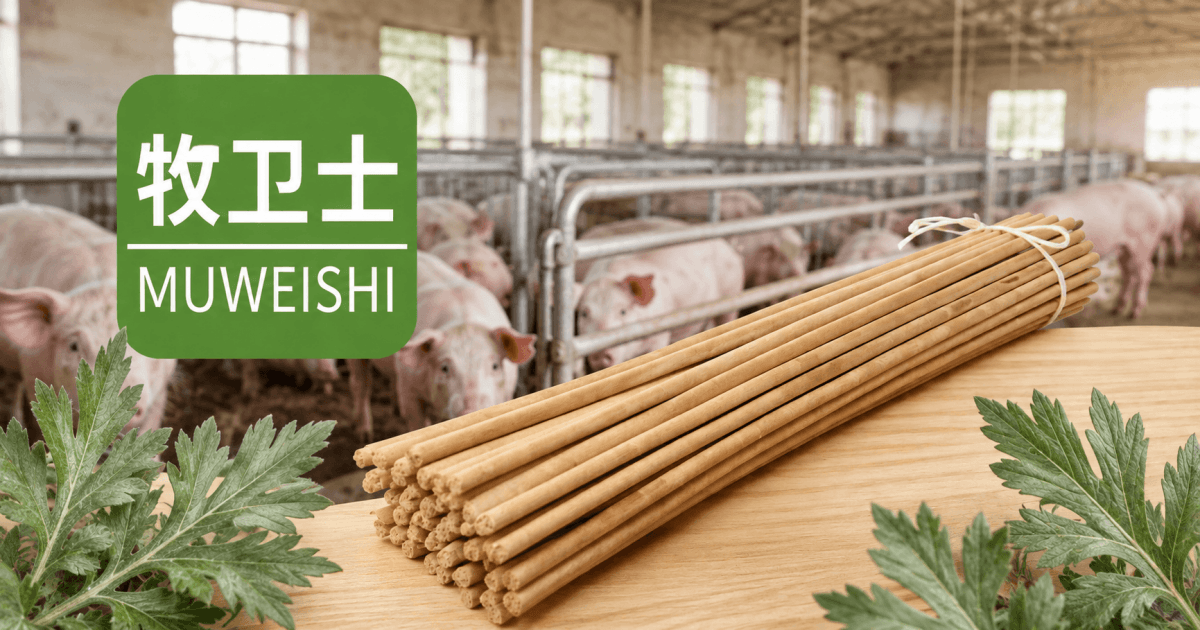
MUWEISHI's three products all use compliant formulas: the Standard for routine farming environments, the Wormwood adding wormwood plant extract for a mild, low-irritation profile, and the Strong for high-density mosquitoes and flies in hot, humid conditions.
2. How It Works: Contact Killing Plus Repellency
Pyrethroid ingredients act on mosquitoes and flies in two main ways:
- Contact killing: As mosquitoes and flies fly or land, they contact active-ingredient particles suspended in the air. The ingredient penetrates the cuticle and disrupts the insect nervous system, causing excitation, paralysis, and eventual knockdown and death. The smoke released by a burning coil builds a field of suspended particles in the pen; insects passing through it are continuously exposed.
- Repellency: The active ingredient and its combustion odor have a clear repelling effect on mosquitoes and flies, discouraging them from entering or staying in the covered area. This creates a dual barrier of "repel and kill."
The two actions combined let a livestock coil both rapidly reduce existing mosquito and fly density and continuously block outside insects from re-entering. This is why activity noticeably drops about 10 minutes after lighting.
3. Why It Suits Large-Area Overnight Farm Protection
Mosquito and fly control on farms has distinct characteristics that match the strengths of pyrethroid livestock coils:
- Large spaces, many pens: Pig farms, cattle and sheep sheds, and poultry houses often cover hundreds to thousands of square meters. Sprays or electric vaporizers struggle to cover such areas. Livestock coils use a stick form; a single 1.2m long stick covers 60-80 sqm, and even placement along aisles builds a continuous concentration field.
- Need for full-night protection: Peak mosquito and fly activity runs from evening to early morning, exactly when livestock need quiet rest. A livestock coil burns 8-10 hours per stick, covering the entire night peak without repeated manual relighting.
- Complex, well-ventilated environments: Open or semi-open sheds have strong airflow where ordinary household coils cannot maintain concentration. Livestock coils are designed with release rates and burn speeds tuned for large spaces, keeping effective concentration even under ventilation.
- Fast action, simple operation: Light early at dusk, with effect within 10 minutes. No complex equipment is needed, fitting daily use by frontline farm staff.
For detailed burn-time and coverage figures, see How Long Does One Livestock Mosquito Coil Burn and How Much Area Does It Cover?.
4. Formulation Differences vs Household Coils
A frequent question: can household coils be used directly on a farm? The answer is no. The two differ clearly in formulation orientation:
| Dimension | Household coil | Livestock coil |
|---|---|---|
| Use space | Small indoor rooms, tens of sqm | Large pens, tens to hundreds of sqm |
| Formula focus | Light scent, low smoke, indoor comfort | Active-ingredient release and sustained coverage |
| Burn format | Mostly coil discs, short burn | Stick format, 8-10 hours overnight per stick |
| Target | Human living space | Livestock environment, accounting for animal tolerance |
| Use frequency | Occasional | Every night, continuous, demanding stability |
For a detailed comparison, see Livestock vs Household Mosquito Coil: What's the Difference?. In short, household coils are optimized for indoor human comfort, while livestock coils are optimized for large spaces, overnight, and continuous use. Moving a household coil to a farm usually means insufficient concentration and duration; moving a livestock coil to a bedroom means a heavier scent and unsuitable format.
In summary, the active ingredients in livestock mosquito coils are primarily compliant pyrethroid formulas. Through dual contact-killing and repellent action, they build a "kill and repel" barrier in the pen, and paired with the long overnight burn of the stick format, they are especially suited to the large-area, full-night, continuous protection needs of farms. As a source factory, MUWEISHI offers the standard, wormwood, and strong types in full, all with compliant formulas and custom solutions available. To learn about formula details and pricing, contact us.
FAQ
What are the active ingredients in livestock mosquito coils?
Compliant livestock mosquito coils generally use pyrethroid-class compounds as the active mosquito-repelling ingredient. These are synthetic compounds built on the structure of natural pyrethrin, with low residue and low mammalian toxicity. The exact chemical names, precise contents, and applicable standard numbers belong to the product's technical documentation - confirm them against the manufacturer's test reports and instructions.
How do livestock mosquito coils work?
Pyrethroid ingredients act through two mechanisms: contact killing and repellency. As insects fly or land, they contact active-ingredient particles suspended in the smoke, which penetrate the cuticle and disrupt the insect nervous system, causing excitation, paralysis, and knockdown; the combustion odor also repels insects from entering or staying in the covered area. Combined, they create a dual barrier of repel and kill, with activity noticeably dropping about 10 minutes after lighting.
Why are livestock mosquito coils different from household mosquito coils?
Household coils are optimized for small indoor rooms with light scent and low smoke, while livestock coils are optimized for large spaces - a single 1.2 m stick covers 60-80 sqm and burns 8-10 hours overnight - with release rates tuned for open, well-ventilated sheds and continuous nightly use. Using a household coil on a farm usually means insufficient concentration and duration, and moving a livestock coil to a bedroom means a heavier scent and unsuitable format.